
In 1989, the United States Mints in Philadelphia (P), Denver (D), and San Francisco (S) produced a combined total of over 1.4 billion Washington quarters.
The total mintage volume was distributed as follows:
Philadelphia (P): 809,424,000 units.
Denver (D): 607,399,030 units.
San Francisco (S, Proof): 3,220,194 units.
Given such massive production scales, the vast majority of 1989 quarters possess no numismatic value exceeding their face value.
The rarity of specific 1989 quarter errors is determined by its preservation on the Sheldon scale and the presence of specific manufacturing defects confirmed by grading companies (PCGS or NGC).
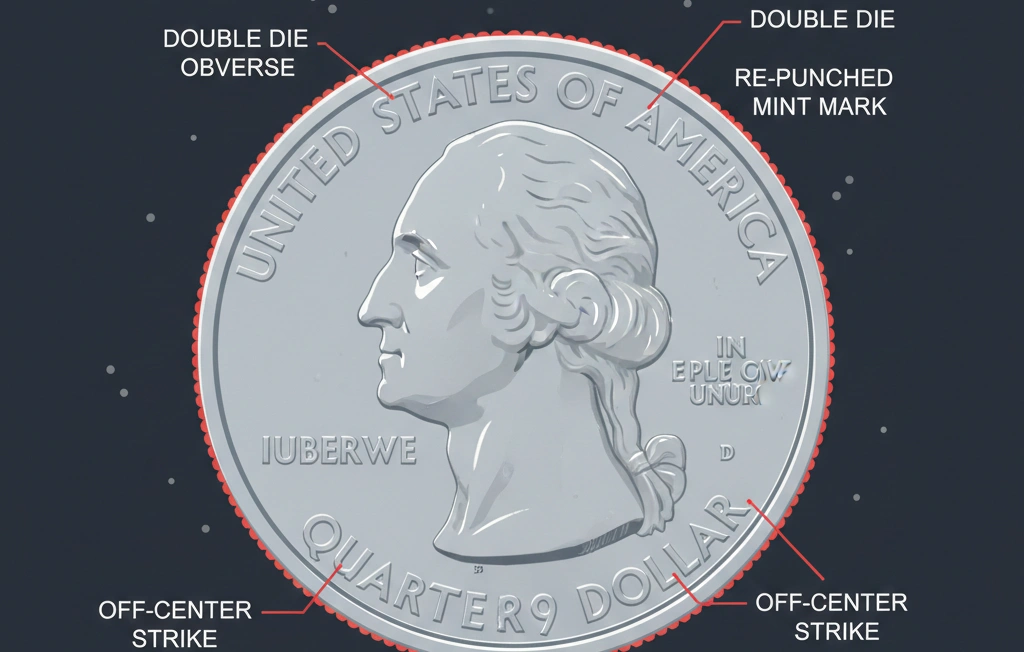
Value Statistics Based on Condition
The market value of coins without manufacturing errors correlates directly with their assigned grade.
Grade | 1989-P (Philadelphia) | 1989-D (Denver) |
MS63 | $0.25 - $1 | $0.25 - $1 |
MS65 | $2 - $5 | $2 - $5 |
MS66 | $15 - $25 | $15 - $25 |
MS67 | $150 - $400 | $100 - $250 |
The record price for a 1989-D in MS67 condition reached $748, recorded at a Heritage Auction in 2018.
Specimens of 1989-P in MS68 condition occur extremely rarely, reaching price points above $3,000 during public trades.
Classification and Analysis of 1989 Mint Errors
Production errors occur during different stages of the minting process, creating unique physical characteristics in the object.
Planchet Errors
Planchet defects precede the actual image application process.
Wrong Weight or Composition. Occasionally, quarters are struck on planchets intended for other denominations.
Cases involving 1989 quarters struck on 10-cent (Dime) planchets have been documented.
Such a coin features a smaller diameter and a weight of 2.27 grams instead of the standard 5.67 grams.
The value of such lots at auction fluctuates between $400 and $800.Lamination Cracks. Impurities in the copper-nickel alloy cause peeling of the coin surface.
Occurring relatively frequently, this defect increases the coin's value by $5–$20.
Striking Errors
This category includes defects originating directly at the moment of the die strike.
Double Struck. A coin failing to exit the workspace after the first cycle receives a second displaced image.
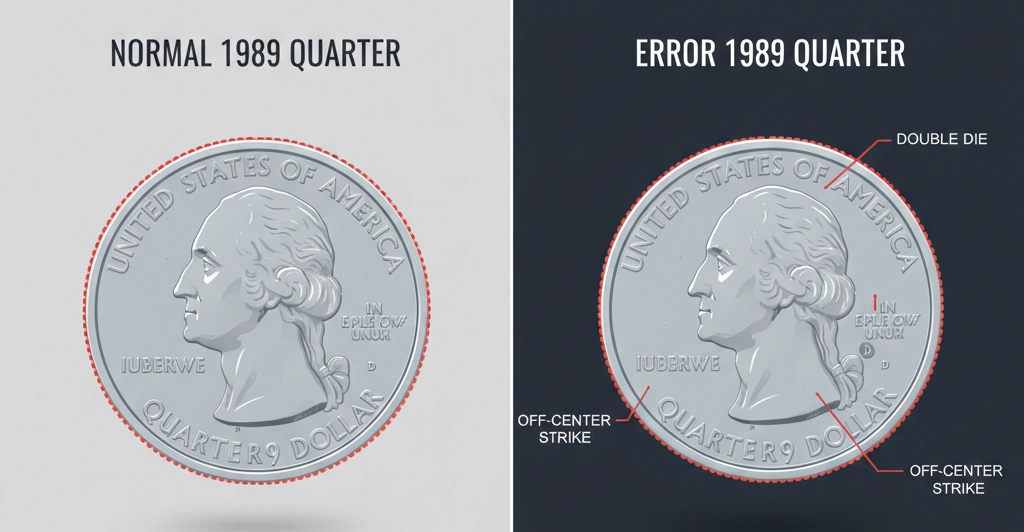
Specimens featuring a displacement of more than 50% are valued in the range of $150–$350.Off-Center Strike. Displacement of the planchet relative to the dies leads to a partial loss of the image.
The percentage of displacement determines the final price:
10–20% displacement: $20 - $40.
50% displacement with a visible date: $75 - $150.
Die Cracks. Wear on the working tool leads to the appearance of raised lines on the coin surface.
Small cracks are not considered rare, however, large formations (e.g., the "Cud" type affecting the rim) raise the price to $50–$100.
Broadstruck Errors
The absence of a retaining collar at the moment of impact causes uncontrolled metal expansion.
The coin becomes thinner and wider than standard parameters, losing the reeding on the edge.
The price for a certified specimen ranges from $30 to $70.
Price Dynamics for Rare Specimens
The investment attractiveness of mint errors demonstrates moderate volatility.
Analysis of data from the last 10 years allows for the identification of the following patterns:
High-Grade Coins (MS67+): Annual value growth remains at 4–6% resulting from the gradual removal of high-quality coins from circulation.
The number of available specimens in PCGS or the free coin identifier registries remains stable, creating a deficit amidst rising demand.Mass Errors (small cracks, minor displacements): The price of these objects stagnates, showing fluctuations within inflation expectations (1–2% per year).
Unique Errors (Major Errors): The value of rare errors existing in single specimens increases in steps.
Reselling such assets every 5–7 years typically yields the owner a 25–40% profit from the original price.
Specifications of a Standard 1989 Coin
Identifying an error requires knowledge of the standard release parameters:
Composition: Copper-nickel alloy (91.67% copper, 8.33% nickel).
Diameter: 24.26 mm
Weight: 5.67 grams
Thickness: 1.75 mm
Edge: Reeded (119 reeds)
Any deviation from these parameters, not caused by circulation wear, is classified as a potential manufacturing error.
Probability of Discovering Rare Errors
The statistical probability of finding a valuable coin in regular circulation (pocket change) remains extremely low.
Most significant defects were discovered and cataloged in the first decades following the release.
However, the possibility of finding the following types of errors in unsearched bank rolls persists:
Struck Through Grease. Technical lubricant entering the die details makes parts of the inscriptions invisible.
Specimens featuring a missing date or mint mark are particularly valued, provided there is confirmed absence of mechanical tampering.Doubled Die. No significant "Major Doubled Die" errors comparable in rarity to the 1969-S or 1972 releases have been recorded for 1989.
Existing micro-doubling on letters (DDO/DDR) adds only minor sums to the coin's value (from $5 to $20).
Value Verification Process
Self-assessment of a coin often leads to identification mistakes without or with the coin appraisal app.
The algorithm for confirming rarity includes the following stages:
Weighing on high-precision scales (to 0.01 g). This helps exclude counterfeits and confirm strikes on incorrect planchets.
Microscopic examination. This allows for distinguishing manufacturing errors from post-mint damage (PMD).
Comparison with auction databases (Heritage, Stack's Bowers). This provides an understanding of the current market price for similar positions.
Submission for grading. Only coins encapsulated in holders from reputable companies are considered investment-attractive.
Final Rarity Assessment
The rarity of 1989 errors is a relative value.
The classification of rarity by type is provided below:
Common: Die cracks, filled letters, minor displacement. Occurring in 1 out of 50,000 coins.
Scarce: Off-center strikes (up to 25%), broadstrikes. Occurring in 1 out of 500,000 coins.
Very Rare: Planchet errors, significant displacement, double strikes. Occurring less frequently than 1 in 5,000,000 coins.
The absence of precious metals in 1989 coins makes their value dependent exclusively on production uniqueness and the physical condition of the surface.
Based on registry data, the number of 1989 coins in ideal condition (MS68 and above) constitutes less than 0.001% of the total mintage.
A combination of a high grade and a rare error automatically transfers the coin into the category of museum exhibits with a price exceeding the face value thousands of times.
Conclusion
The market for 1989 mint errors demonstrates stability conditioned by the absence of new mass discoveries.
Stagnation of supply while maintaining interest from professional numismatists ensures the protection of invested capital.
Acquiring certified specimens with clear striking defects is a strategy minimizing the risks of asset devaluation.
1989 coins possessing confirmed planchet defects or significant die displacements remain in-demand lots at specialized trades.